Whilst doing a couple of new posts this morning I realised we've ticked over a minor milestone on the blog and passed the 20,000 visits mark. Along the way we've also accumulated 35 followers.
To quote a famous figure from the past "This is not the end. It is not even the beginning of the end. But it is, perhaps, the end of the beginning."
A massive thanks to all who have dropped by, got involved with comments and advice and especially those loyal few who follow our blog.
Cheers,
Millsy

Tuesday, 10 July 2012

Song of Drums & Shakos French and British Project
One of our allies in the West is getting into Song of Drums and Shakos which the same system we use for Napoleonic skirmish games. Adam is going to do an ongoing review of his forces as he builds them up. Here's the first instalment...
I have received my copy of the Ganesha Games 'Songs of Drums and Shakos' and decided I would finally crack on with a couple of small forces to play with as it looks like a fun system.
For those of you who are not familiar they are a skirmish set of rules which are about 400 points a side which translates into roughly 8-12 figures per side obviously depending on the quality. Eg a basic French and British Line infantryman are worth 33 points each. There is the rules set called Songs of Drums and Shakos (which has the rules a couple of scenarios and lists for the big nations of France, Austria, Britain, Russia and Prussia) and a supplement called More Songs of Drums and Shakos which add lists for the rest of the nations and a few more scenarios and rules.
I bought the rules from Lulu (http://www.lulu.com/shop/search.ep?type=&keyWords=Songs+of+Drums+and+Shakos&x=8&y=4&sitesearch=lulu.com&q=) which was the first time I had ordered from this mob and altogether the rules cost me a total of $35 for the both of them. I ordered them while in Melbourne and was very pleasantly surprised to have them arrive quite quickly. I also really like the look of them and have pored over them since getting them.
So I had the rules and I know from Mike and from Mark, my other mate, that there were a pretty good set of rules and of course they won an award at Origins so they are highly regarded.
I had of course a substantial collection of figures already painted and would just need re-basing but I decided that I would start from scratch as I not only want some French and British but I had some of the relatively new Victrix figures which I had bought some time ago.
I decided that I wanted to light infantry forces for both sides and I had also purchased the Light Infantry heads blister from Victrix. I have seen the pictures of the painted Victrix stuff and they look really good and of course they are very good value for money compared to the metal ones.
After a basic white undercoat I will do the basic colours and then intend to use the army painter dipper which I have become a big fan of. I can still do highlighting and shading but these days I am far more inclined to use the army painter dip which I have been more than happy with. I used the Army Dipper white primer and I am not happy with it. I found that it sprays a bit spotty even after a good shake and is a bit gritty in application - you can see the spots in the image. Love them or loathe them I find the Games Workshop white primer the best and would not buy the Army Painter primers again. I have the black as well and that is slightly better but will change back to GW. No saving in price these days anyway.
I built the British first and used the Peninsular War Flank Company box to get the right shoulder decorations. The various bits came off the sprue easily enough with a set of clippers and not too much in the way of tags to trim. Flashing was very minimal being just a touch on the backpacks and water bottle strap. In terms of the arm placement on the sprue the matching left and right weren't too bad but think they could be better placed as the pairings are not that obvious - to me anyway. The left and right are separate and I must admit to a bit of fiddling get them to sit right which was irritating. I much prefer the Perry Brothers style with both arms and weapon all attached together. Less variation but not as frustrating glueing together.

The metal heads were cut of the sprue and with just a little flash they were ready. I tended to glue all the plastic together and then put on the heads. I used Liquid Nails but you can use superglue. One thing I noticed with the metal heads is that they seem to be small compared to the figure and this seemed to stand out particularly before they were undercoated. They don't seem as bad undercoated but they still small. This was particularly noticeable when compared to the French figures which seem big headed in comparison. The British heads also seem to make the figures chinless which again makes them stand out from the French. Perhaps the normal line plastic heads will look better.
One thing in the rules that you need is a Sergeant and Victrix does have two figures which can be used for the command. In the British box one is obviously the officer in hessian boots and the other in trousers which is the one I used for the Sergeant. The only problem I see with this figure though is that they have a sword moulded onto the left leg which is not appropriate for the NCOs. I should point out that I have the Centre Co box as well and this has a left arm with pike. You could choose a normal figure for the NCO but you would not have the sash on the figure. The Light Infantry Sergeants didn't carry a pike though so I have given mine a musket which you can see second from the left. In the blister for the heads you also get the left and right arms for the Light Co bugler although they only come in one pose.
When doing in the French I found the left and right arms match not very intuitive and had some fiddling around to get them right. It should be pointed out that the French box has 60 figures in it including the Elite Company figures unlike the British range which has separate boxes for the flank and centre. The selection of head is good and you have about a dozen Grenadier bearskins and the same of long plumed shako heads. Being a Voltiguer section I decided to give my boys all tall plumes as they look better than way. Given the body of the figure is more of a campaign figure I should probably have gone with a more basic shako but I like plumes! As I mentioned earlier the French heads are bigger than the British metal ones and are much better proportioned. I could rip off the metal ones and put the plastic ones on but they are the wrong design having a shako plate not the bugle.

Aside from the arms I found the briquet (hanger and bayonet combo) on the sprue frustrating to get off. It is a thin piece of plastic and yet has been attached to the sprue in a tight spot with some 4-5 attachments. I managed to get them off OK but they could have been made easier to do. One thing to note is that with the limited number of figures you will end up using non elite company bodies for them. You can tell this as some have the crossbelt which had the briquet off it and some don't. I didn't do a separate French Sergeant figure as he will be painted differently to make him stand out.
The poses of both sets are OK for the skirmishing poses that I want and I am sure they will be better for the centre company marching pose. But I have 12 figures per side with Officer, hornist and Sergeant and 9 privates/soldats. The few kneeling figures I quite liked though.

Building just 24 figures though was a slow and fiddly business and one that I would lose a bit of patience with if I was doing larger units. On that experience alone I would opt for the metals but I will wait until I have my figures painted before offering a final verdict. Having built a heap of Perry War of the Roses figures (120 or so) I can say that experience was a better one and much prefer 3-4 pieces to glue rather that the 5-6 with Victrix. Yes they are value for money per figure but glueing them together too some 3-4 hours for just 24 figures. Maybe I am just too slow doing it but cutting off fiddly bits of the sprues was not as easy as the Perry or GW stuff I have done.
So that was my initial impression and the next steps will be painting. As I said I will do basic colours and then brush on the Army Dipper. This worked very well for the Perry War of the Roses stuff so I am happy with the method.
Next instalment will be painted figures and I will measure them up to some of my other ranges for a size comparison.
Cheers
Adam
I have received my copy of the Ganesha Games 'Songs of Drums and Shakos' and decided I would finally crack on with a couple of small forces to play with as it looks like a fun system.
For those of you who are not familiar they are a skirmish set of rules which are about 400 points a side which translates into roughly 8-12 figures per side obviously depending on the quality. Eg a basic French and British Line infantryman are worth 33 points each. There is the rules set called Songs of Drums and Shakos (which has the rules a couple of scenarios and lists for the big nations of France, Austria, Britain, Russia and Prussia) and a supplement called More Songs of Drums and Shakos which add lists for the rest of the nations and a few more scenarios and rules.
I bought the rules from Lulu (http://www.lulu.com/shop/search.ep?type=&keyWords=Songs+of+Drums+and+Shakos&x=8&y=4&sitesearch=lulu.com&q=) which was the first time I had ordered from this mob and altogether the rules cost me a total of $35 for the both of them. I ordered them while in Melbourne and was very pleasantly surprised to have them arrive quite quickly. I also really like the look of them and have pored over them since getting them.
So I had the rules and I know from Mike and from Mark, my other mate, that there were a pretty good set of rules and of course they won an award at Origins so they are highly regarded.
I had of course a substantial collection of figures already painted and would just need re-basing but I decided that I would start from scratch as I not only want some French and British but I had some of the relatively new Victrix figures which I had bought some time ago.
I decided that I wanted to light infantry forces for both sides and I had also purchased the Light Infantry heads blister from Victrix. I have seen the pictures of the painted Victrix stuff and they look really good and of course they are very good value for money compared to the metal ones.
After a basic white undercoat I will do the basic colours and then intend to use the army painter dipper which I have become a big fan of. I can still do highlighting and shading but these days I am far more inclined to use the army painter dip which I have been more than happy with. I used the Army Dipper white primer and I am not happy with it. I found that it sprays a bit spotty even after a good shake and is a bit gritty in application - you can see the spots in the image. Love them or loathe them I find the Games Workshop white primer the best and would not buy the Army Painter primers again. I have the black as well and that is slightly better but will change back to GW. No saving in price these days anyway.
I built the British first and used the Peninsular War Flank Company box to get the right shoulder decorations. The various bits came off the sprue easily enough with a set of clippers and not too much in the way of tags to trim. Flashing was very minimal being just a touch on the backpacks and water bottle strap. In terms of the arm placement on the sprue the matching left and right weren't too bad but think they could be better placed as the pairings are not that obvious - to me anyway. The left and right are separate and I must admit to a bit of fiddling get them to sit right which was irritating. I much prefer the Perry Brothers style with both arms and weapon all attached together. Less variation but not as frustrating glueing together.

The metal heads were cut of the sprue and with just a little flash they were ready. I tended to glue all the plastic together and then put on the heads. I used Liquid Nails but you can use superglue. One thing I noticed with the metal heads is that they seem to be small compared to the figure and this seemed to stand out particularly before they were undercoated. They don't seem as bad undercoated but they still small. This was particularly noticeable when compared to the French figures which seem big headed in comparison. The British heads also seem to make the figures chinless which again makes them stand out from the French. Perhaps the normal line plastic heads will look better.
One thing in the rules that you need is a Sergeant and Victrix does have two figures which can be used for the command. In the British box one is obviously the officer in hessian boots and the other in trousers which is the one I used for the Sergeant. The only problem I see with this figure though is that they have a sword moulded onto the left leg which is not appropriate for the NCOs. I should point out that I have the Centre Co box as well and this has a left arm with pike. You could choose a normal figure for the NCO but you would not have the sash on the figure. The Light Infantry Sergeants didn't carry a pike though so I have given mine a musket which you can see second from the left. In the blister for the heads you also get the left and right arms for the Light Co bugler although they only come in one pose.
When doing in the French I found the left and right arms match not very intuitive and had some fiddling around to get them right. It should be pointed out that the French box has 60 figures in it including the Elite Company figures unlike the British range which has separate boxes for the flank and centre. The selection of head is good and you have about a dozen Grenadier bearskins and the same of long plumed shako heads. Being a Voltiguer section I decided to give my boys all tall plumes as they look better than way. Given the body of the figure is more of a campaign figure I should probably have gone with a more basic shako but I like plumes! As I mentioned earlier the French heads are bigger than the British metal ones and are much better proportioned. I could rip off the metal ones and put the plastic ones on but they are the wrong design having a shako plate not the bugle.

Aside from the arms I found the briquet (hanger and bayonet combo) on the sprue frustrating to get off. It is a thin piece of plastic and yet has been attached to the sprue in a tight spot with some 4-5 attachments. I managed to get them off OK but they could have been made easier to do. One thing to note is that with the limited number of figures you will end up using non elite company bodies for them. You can tell this as some have the crossbelt which had the briquet off it and some don't. I didn't do a separate French Sergeant figure as he will be painted differently to make him stand out.
The poses of both sets are OK for the skirmishing poses that I want and I am sure they will be better for the centre company marching pose. But I have 12 figures per side with Officer, hornist and Sergeant and 9 privates/soldats. The few kneeling figures I quite liked though.

Building just 24 figures though was a slow and fiddly business and one that I would lose a bit of patience with if I was doing larger units. On that experience alone I would opt for the metals but I will wait until I have my figures painted before offering a final verdict. Having built a heap of Perry War of the Roses figures (120 or so) I can say that experience was a better one and much prefer 3-4 pieces to glue rather that the 5-6 with Victrix. Yes they are value for money per figure but glueing them together too some 3-4 hours for just 24 figures. Maybe I am just too slow doing it but cutting off fiddly bits of the sprues was not as easy as the Perry or GW stuff I have done.
So that was my initial impression and the next steps will be painting. As I said I will do basic colours and then brush on the Army Dipper. This worked very well for the Perry War of the Roses stuff so I am happy with the method.
Next instalment will be painted figures and I will measure them up to some of my other ranges for a size comparison.
Cheers
Adam
Springtime for Hitler - FoW MW Grenadierkompanie
This is the beginnings of a Mid War Eastern Front German Grenadierkompanie for Flames of War. I've been wanting to do one for years and finally decided it was time. Not much else was interesting me and it was good to find something to spark my enthusiasm.
I'm kind of going about this backwards as my combat platoons are on back order and my HQ has only just arrived in the post. At least once I finish them I'll have the whole army done I suppose because I won't be able to play until I've completed the minimum requirements...
The crew figures for the guns are something of a mishmash. I've had some VERY unusual packing experiences with these including a wounded Russian in an 8cm mortar pack. At least he found a home in the bailed crew for the armour. ;-)
So here we have some regimental and divisional support platoons. Remember to click for bigger images.
I know the Kettenkrads are not legal in the list but I had them hanging about so they got painted...
On the painting table at the moment I have the HQ, heavy infantry guns and some black pioneers. On back order I have two grenadier platoons, an MG platoon and a 12cm mortar platoon. I've got a couple of weedy lookin' Marder I's as well.
All up I should be able to do an easy 2,000pts with plenty of options for supports. The pioneers can morph into an Assault Group with various guns, flamers, MG, etc as options and the other support options can change in and out for plenty of variety.
Cheers,
Millsy
I'm kind of going about this backwards as my combat platoons are on back order and my HQ has only just arrived in the post. At least once I finish them I'll have the whole army done I suppose because I won't be able to play until I've completed the minimum requirements...
The crew figures for the guns are something of a mishmash. I've had some VERY unusual packing experiences with these including a wounded Russian in an 8cm mortar pack. At least he found a home in the bailed crew for the armour. ;-)
So here we have some regimental and divisional support platoons. Remember to click for bigger images.
.jpg) |
| PaK36(r) platoon |
2.jpg) | ||
| PaK36(r) |
 |
| PaK36 platoon with transport |
 |
| PaK36 with transport |
 |
| Nebelwerfer battery |
 | |
| Nebelwerfer and command / observer |
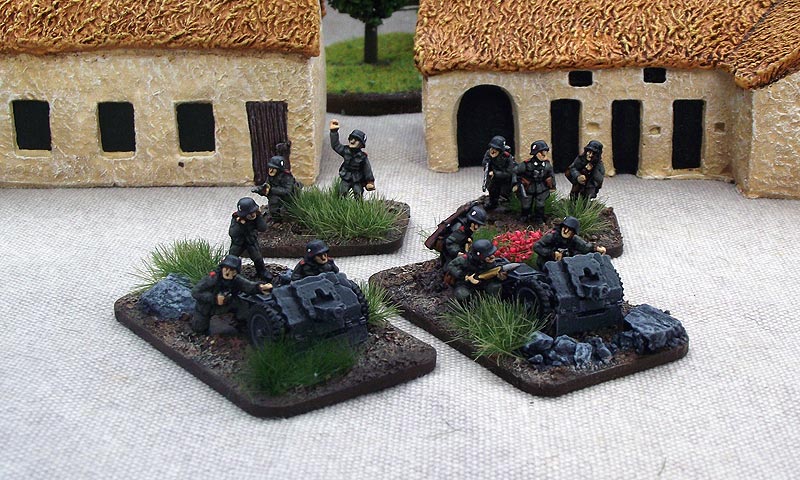 |
| leIG18 light infantry gun platoon |
 |
| StuG F/8 platoon |
On the painting table at the moment I have the HQ, heavy infantry guns and some black pioneers. On back order I have two grenadier platoons, an MG platoon and a 12cm mortar platoon. I've got a couple of weedy lookin' Marder I's as well.
All up I should be able to do an easy 2,000pts with plenty of options for supports. The pioneers can morph into an Assault Group with various guns, flamers, MG, etc as options and the other support options can change in and out for plenty of variety.
Cheers,
Millsy
Monday, 11 June 2012
Operation Lightbeer - Flames of War MW Desert AAR
Driven back to hasty the fortifications at Alamein, the Australians and British dig in and prepare to repel the relentless advance of Rommel and his Desert Afrika Corps. Outside it was wet and miserable but on the table the heat was relentless, the foes implacable and the result as close as could be. Can the Germans capture the objective and save themselves from a diet of lightbeer?
On the defending side we had a 2000 point British Guards Motor company consisting of motor platoons, heavy machine guns, Royal Horse Artillery, 6pdr portee AT, Grant tanks and carriers plus a 2000 point Australian rifle company consisting of rifle platoons, towed 6pdr AT, heavy mortars, carriers, Valentine infantry tanks and Crusaders of the Div Cav with Hurricane IIDs overhead.
On the attacking side we had Rommel in command of 2000 points of Panzergrenadiers consisting of schutzen platoons, panzers, heavy artillery and nebelwerfers plus 2000 points of Panzerpioneers consisting of pioneers, panzers, Lorraine Schleppers and Stukas.
The table was 8" x 6" which meant for a wide frontage and a lot of barbed wire. We played Trench Fight which meant minefields were short in supply due to cost in points. Deciding to force the DAK into a path covered by the AT guns, the Allied right was left without mines - a bad decision as it turned out. The preliminary bombardment did little to disrupt the infantry but did knock out a couple of 25pdrs. More crucially it all but destroyed the 6pdr AT guarding the Allied right.
The Germans made a determined attack on both flanks. Initial success on their right was slow with infantry sacrificing itself to clear a path for the panzers.
Too little too late the Grants and carriers arrive en masse. Appalling Allied reserve rolls mean the Germans have ground their way onto the objective with reduced opposition. Another turn would have seen an Allied victory due to increasing numbers with all but two of the dozen panzers brewed up.
In the end it wasn't to be an Allied victory. What had looked a certainty for the Germans swung back in Allied favour before a critical turn handed victory to Rommel.
On the defending side we had a 2000 point British Guards Motor company consisting of motor platoons, heavy machine guns, Royal Horse Artillery, 6pdr portee AT, Grant tanks and carriers plus a 2000 point Australian rifle company consisting of rifle platoons, towed 6pdr AT, heavy mortars, carriers, Valentine infantry tanks and Crusaders of the Div Cav with Hurricane IIDs overhead.
On the attacking side we had Rommel in command of 2000 points of Panzergrenadiers consisting of schutzen platoons, panzers, heavy artillery and nebelwerfers plus 2000 points of Panzerpioneers consisting of pioneers, panzers, Lorraine Schleppers and Stukas.
 |
| RHA dug in behind the trench lines |
 | |
| Aussies on the objective, prepared to fight to a bitter end (pun intended!) |
 |
| View from the German left flank, it was here the initial breakthrough came |
The table was 8" x 6" which meant for a wide frontage and a lot of barbed wire. We played Trench Fight which meant minefields were short in supply due to cost in points. Deciding to force the DAK into a path covered by the AT guns, the Allied right was left without mines - a bad decision as it turned out. The preliminary bombardment did little to disrupt the infantry but did knock out a couple of 25pdrs. More crucially it all but destroyed the 6pdr AT guarding the Allied right.
 |
| View from the Allied left flank |
 |
| German AT on the ridge in the centre, panzers advancing behind |
The Germans made a determined attack on both flanks. Initial success on their right was slow with infantry sacrificing itself to clear a path for the panzers.
 |
| German right flank - panzers forward! |
 |
| The Guards holding fast as the Germans advance |
 |
| The German rear, artillery preparing to blast the defenders |
 |
| German start line showing the whole table |
On the German left massed panzers advance across the wire, following a path which had been covered by Allied AT before the bombardment. With no minefields and only infantry in their path there is little to stop them. Allies reserves are disastrously late, arriving first on turn three and only in dribs and drabs. This was to be crucial...
 |
| Panzers force the gap on the German left |
 |
| With the Allied infantry cleared, the panzers advance |
At last the Allied reserves begin to arrive. It looked far too late with the panzers within one move of the objective but the Valentines and 6pdr portees worked wonders, stopping the panzers and plugging the narrow gap with burning wrecks. Successive waves of panzers then foundered on the trenches to be destroyed by the few remaining 25pdrs firing over open sights.
 |
| The Valentines come to the rescue with empty gun pits everywhere |
 |
| A growing park of buring tanks and the German breakthrough grinds to a halt |
Meanwhile on the German right the panzers and pioneers have forced another gap and advanced. The panzers halted and engaged in an ineffective long range gun duel with late arriving Grants but made a critical difference in preventing the tanks advancing to support the objective. The pioneers broke into the trench network and advanced lengthwise under cover. They finally threw the Aussies out but not before they had destroyed a platoon of panzers with pure guts and sticky bombs.
 |
| Desperately weak pioneers have the objective. Destroyed Valentines abound |
Too little too late the Grants and carriers arrive en masse. Appalling Allied reserve rolls mean the Germans have ground their way onto the objective with reduced opposition. Another turn would have seen an Allied victory due to increasing numbers with all but two of the dozen panzers brewed up.
In the end it wasn't to be an Allied victory. What had looked a certainty for the Germans swung back in Allied favour before a critical turn handed victory to Rommel.
Sunday, 10 June 2012
Flames of War Desert Defences
We've got a large Flames of War desert game on tomorrow - 4,000pts per side in Mid War North Africa.
We're pitting two Commonwealth infantry companies in defence (British Guards Motor and Aussie Rifle) against two German infantry companies in attack (DAK Panzergrenadiers x 2). The game is sort of a prelude to Second Alamein, where the Commonwealth forces have just been driven back to the last line of defence.
The scenario is a Trench Fight and for that we need a network of defences - trenches, minefields, barbed wire and gun pits. I've spent the last week and a bit beavering away producing a pile of suitable terrain and here it is. All of it is hand made, even the mines and barbed wire.
For those who are interested, total cost was something like $80 Aussie. In terms of "entertaining stats" I went through about 40m of wire, 50 tubes of super glue, 6m of timber quadrant and half a kilo of sand to name just some of the ingredients.
Mr Millsy aka "Spare Hand One" was a great help holding the other end of the barbed wire while I cranked my hand drill to give the appropriate twist. Is there nothing a good Aussie girl can't do???


We're pitting two Commonwealth infantry companies in defence (British Guards Motor and Aussie Rifle) against two German infantry companies in attack (DAK Panzergrenadiers x 2). The game is sort of a prelude to Second Alamein, where the Commonwealth forces have just been driven back to the last line of defence.
The scenario is a Trench Fight and for that we need a network of defences - trenches, minefields, barbed wire and gun pits. I've spent the last week and a bit beavering away producing a pile of suitable terrain and here it is. All of it is hand made, even the mines and barbed wire.
For those who are interested, total cost was something like $80 Aussie. In terms of "entertaining stats" I went through about 40m of wire, 50 tubes of super glue, 6m of timber quadrant and half a kilo of sand to name just some of the ingredients.
Mr Millsy aka "Spare Hand One" was a great help holding the other end of the barbed wire while I cranked my hand drill to give the appropriate twist. Is there nothing a good Aussie girl can't do???


Plenty more pics to follow tomorrow when the table is loaded up with figs and more terrain.
Cheers,
Millsy
Subscribe to:
Posts
(
Atom
)
